Back-to-school season: plan office training room bookings
On this page
Your new agents need somewhere to practise a buyer consultation. The experienced agents need somewhere to hold the real one. With three meeting rooms and client appointments continuing throughout the day, an autumn training programme needs more planning than a recurring calendar invitation.
Bring the back-to-school idea into your real-estate office: set aside time for induction, property presentation practice and negotiation workshops. Build the room timetable around those sessions without quietly reserving every client meeting space for the whole morning.
Key takeaway: Plan the participant timetable and the room timetable separately. Setup, equipment checks and clearing away belong in the room reservation even when attendees are not present.
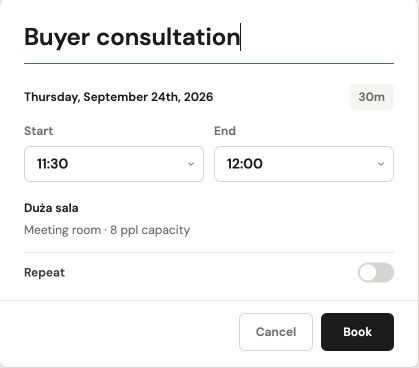
Set the room reservation window separately from the time attendees arrive. Booking form shown before saving.
Start with the session requirements
For each session, write down expected attendance, teaching format and equipment needs. Presenting a property portfolio needs a visible display. Practising a seller consultation needs a table layout that lets agents face each other.
Separate essential requirements from preferences. If participants must work in groups around tables, that layout matters.
Identify who owns the session and approves changes. When a booking moves, someone needs to update the trainer, attendees and any person preparing the room.
A planning sheet can use these fields:
| Field | Induction session plan | Why it matters |
|---|---|---|
| Attendee session | 10:00–11:30 | Defines the invitation time |
| Room reservation | 09:30–11:45 | Includes setup and clearing away |
| Layout | Table seating for consultation practice | Helps the host check suitability |
| Equipment | Display and whiteboard | Identifies what to test beforehand |
| Session owner | Named internally | Gives changes a responsible person |
| Dependencies | Follow-up after introductory session | Prevents an unusable sequence |
Build the sequence before booking the series
Map which sessions must happen in order. A practical exercise might require an introductory briefing first. Separate sessions may also share a trainer or equipment, so a free room alone does not make a time slot suitable.
Check those dependencies before creating recurring reservations. If only three sessions are needed, give the series a definite end. If the dates differ, individual reservations may be easier to understand than a recurring pattern with several exceptions.
For a programme spanning multiple weeks, review each date against room closures and the trainer’s availability. The guide to recurring room bookings explains how to keep an ongoing series accountable.
Decide what happens during breaks
A lunch break creates a practical choice. Can another team use the room, or will materials and equipment remain in place?
If the room remains occupied, reflect that in its reservation. If you release it, allow enough time for the next user to leave and the training host to reset it. Tell the trainer which arrangement you have chosen.
Avoid reserving several spare rooms “just in case” without a decision date. If a breakout space is genuinely needed, give it a defined purpose and time window. Release provisional space when the session format is confirmed.
Fit two induction mornings around client meetings
Plan Tuesday’s property presentation session for 10:00–11:30 in your largest room. Reserve 09:30–11:45 so the trainer can connect a laptop, arrange materials and restore the room before a seller appointment at noon.
Thursday’s negotiation practice builds on that introduction. Schedule it for 10:00–12:00, including a paired exercise from 10:45 to 11:15. Reserve a second room only for the exercise and its handover time. Keep the third available for client appointments rather than holding it as an unspecified backup.
If the trainer asks to start Thursday at 09:00, check every dependency before agreeing. The second room may already hold a buyer consultation at 09:45, just when the earlier breakout exercise would begin. Moving the main session alone leaves the programme without its planned space.
You can keep the original time, redesign the exercise to use one room or find another agreed slot. Confirm the choice with the trainer before updating attendees. Check the effect on client appointments before confirming a new training time.
Make one person responsible for the full set of reservations. A revised training invitation is only complete when the room times and breakout bookings match it.
Make the invitation match the booking
Use the participant start time in the invitation. Include the room name exactly as it appears on the door and in the schedule. If people must bring equipment or complete preparation, state that separately.
Keep setup instructions with the host’s checklist. Attendees do not need to arrive half an hour early merely because the room reservation begins then.
When plans change, update the invitation and the room reservation together. Check linked breakout bookings too. A cancelled main session should not leave its secondary rooms reserved without a reason.
Review the programme after its final session
Ask the session owner whether the room and timing met the plan. Was the layout ready? Did the break arrangement work? Were unused breakout reservations released?
Use those answers to change the next booking brief. If the trainer needed longer to clear materials before a client arrived, adjust that handover. If the paired exercise stayed in one room, reconsider the extra reservation next time.
Common training room questions
Should setup time appear in the booking title?
A clear title can help, but the reserved time must include setup. A note does not protect a room that is still available for somebody else to book.
Should we reserve the same room for every session?
Use the same room when it meets each session’s requirements and is available. Consistency is helpful, but a practical workshop may need a different layout from a presentation.
How do we handle a cancelled session?
Release its rooms, update attendees and review dependent sessions. If a later exercise requires the cancelled introduction, its owner must decide whether to move or adapt it.
For the wider office booking context, explore Venuo for offices and the meeting room booking overview.