Recurring Meeting Room Bookings: A Practical Review Routine
On this page
Your weekly property pipeline meeting now happens on alternate Thursdays, but its room stays reserved every week. In a real-estate office with three meeting rooms, that leftover booking can leave an agent searching for somewhere to meet a seller while a suitable room sits empty.
Recurring reservations solve a real coordination problem: people can plan around a stable place and time. They also need an owner, an end point and a reliable way to handle exceptions. Otherwise the calendar preserves decisions long after the work has changed.
Key takeaway: Treat recurring meeting room bookings as commitments that need review. Give each series an owner and a bounded duration, check individual conflicts and release occurrences that will not be used.
Define the series before reserving it
Start with the activity and its expected duration. A six-week review of new listings has a natural end. An ongoing sales meeting still needs a chosen review date.
Record the organiser, purpose, frequency and room requirements. Keep client names, property addresses and offer details out of the room booking title.
Ask whether the same space is necessary every time. Installed equipment, access needs or a particular layout may justify consistency. Habit alone is a weaker reason to hold a large room when the group has become smaller.
A finite booking horizon is a practical default. Choose one that fits your office’s planning rhythm and explain how renewals work before the first series expires.
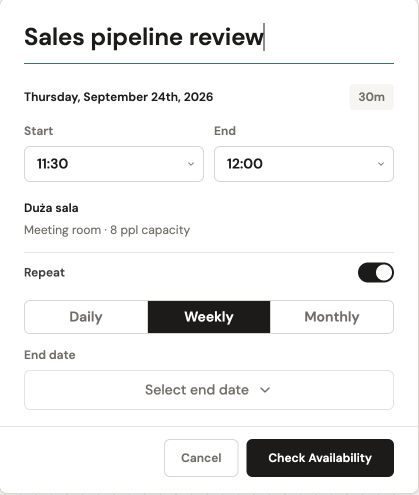
Select the repeat frequency and end date before checking availability for the series. Form shown before saving.
Check occurrences, not just the first week
A free slot next Tuesday does not mean that every later Tuesday is free. Holidays, training days and other reservations can create exceptions within an otherwise regular pattern.
When creating a series, verify the outcome for its full date range. Establish whether your current tool rejects a conflict, skips a date or requires an alternative reservation.
Make any gaps visible to the organiser before attendees rely on the invitation. If one occurrence moves, confirm both the meeting information and the room record. Where a series crosses a clock change or involves colleagues in different time zones, check the displayed local times with them.
Choose the smallest correct change
Editing a recurring booking can affect one date, future dates or the whole series. Before saving, decide which of those reflects the actual change.
| Change in the work | Intended booking change | What to verify afterward |
|---|---|---|
| One meeting is cancelled | Remove that occurrence | The following meeting remains reserved |
| Next week’s meeting needs another room | Move that occurrence | The old room is released for that date |
| The team changes its regular meeting day | Update future reservations | Old future slots are no longer blocked |
| The project ends early | Cancel remaining occurrences | Historical records are retained where appropriate |
| A new organiser takes over | Transfer responsibility or recreate future bookings carefully | There is one clear owner and no duplicate series |
Check which editing controls your booking system provides. If it cannot make a narrow change, document the manual steps and verify the reservations after completing them.
Review a six-week property pipeline meeting
You want your agents to meet every Thursday from 10:00 to 10:45 for six weeks. Of your three meeting rooms, the larger one has the screen and seating the group needs. It is free for five dates, but already reserved for a client negotiation in week four.
Confirm the five available dates, then resolve the exception before sending the series invitation. If a smaller room cannot accommodate the team, look for another time in the larger room. Do not reserve an unsuitable alternative simply to complete the pattern.
Once the fourth meeting has an agreed place and time, check that its invitation matches the room reservation. Tell the agents about the exception directly; a familiar weekly routine makes a changed location easy to miss.
During week three, you decide to skip the fifth meeting because the agents will be out on viewings. Cancel that occurrence and verify that week six remains reserved. Before the final meeting, decide whether another cycle is useful and whether the same room still fits. Renew against actual availability, rather than leaving the room blocked indefinitely.
Run a short recurring-booking review
Choose a review interval that matches how quickly your office plans change. Review ended listing campaigns and changed sales routines without waiting for the seasonal reset.
Ask each organiser to confirm three things: the series still happens, the room still fits and the remaining dates are needed. Include the booking reference and reply deadline.
Do not silently delete reservations because an organiser misses a message. Follow up through the agreed office contact, especially when responsibility may have changed. If your policy permits release after non-response, communicate that policy in advance and notify affected organisers before applying it.
Record the owner, next review date and action taken. You need confirmation that the room is required, not the meeting content.
Questions worth answering in your office guide
Who owns a series when an employee leaves?
Assign the future meetings to an accountable organiser before removing their access where possible. Check the reservation record separately from the meeting invitation; ownership may not transfer together.
Should a recurring booking have priority over a one-off request?
A confirmed series deserves the same clear handling as other reservations. Exceptional changes should follow a published process, with suitable alternatives and direct notice to the organiser.
What belongs in a renewal request?
Include the proposed date range, frequency, duration, attendee count and essential room requirements. Reconfirm these instead of copying the previous series without checking.
For conflicts outside recurring series, see how to prevent double booking meeting rooms. If training drives the new schedule, use the training room scheduling guide. Explore Venuo’s meeting room booking approach as you review the process your office needs.